YuanLi Group · Research

Research Topics
Molecular Electronics and Thermoelectric
Study of thermoelectric effects with molecular junctions is an effective strategy in understanding the mechanisms of transition between heat and electricity at atomic/molecular level and is a promising system for future development of electrical energy generator or cooling elements at nanoscale. The thermoelectric measurements in our group are conducted by the EGaIn technique. Fig. 1a and b show schematic illustrations of a test platform for molecular thermoelectric junctions using EGaIn as the top-electrode, and a polyimide (PI) film embedded with multiple heating resistors is used to heat the bottom-electrode generating temperature difference across junctions. Molecules were assembled on gold (Au) bottom-electrodes and the conical shaped tips of EGaIn were used to conformally contact the top-surface of SAMs eventually forming molecular thermoelectric junctions. When Au electrode was heated, Seebeck coefficient of SAMs, according to Seebeck effect, can be determined by measuring the thermoelectric voltage across the junction and deducing the relationship between thermoelectric voltage and Seebeck coefficient.
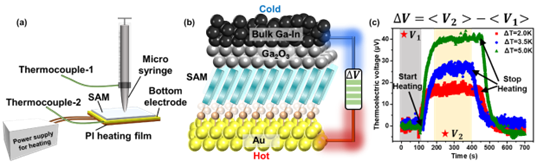
Fig. 1: (a) Schematic diagram of thermoelectric testbed via EGaIn technique. (b) Schematic of SAM-based thermoelectric junction. (c) Thermoelectric voltage of AuTS-SAMs//Ga₂O₃/EGaIn junctions at ΔT = 2.0 K (red), 3.5 K (blue) and 5.0 K (green).
Typical thermoelectric-voltage traces of the AuTS-SAMs//Ga₂O₃/EGaIn junctions at different temperature difference are shown in Fig. 1c. Wherein, V₁ refers to the initial voltage across a junction without temperature difference (the magnitude of V₁ originated from chemical potential difference at the SAM/electrode interface), the average of V₁ (<V₁>) and its standard deviation could be obtained over ~100s test duration (rate of data acquisition: 10 data points of voltage per second) with a Gaussian fit. Once we heated the bottom-electrode, temperature difference occurred and the measured voltage was positively shifted, indicating charge transport was dominated by the HOMO. When the junction reached thermal equilibrium, the average of V₂ (<V₂>) and its standard deviation were calculated over 200 s test time with a Gaussian fit. Then, the thermoelectric voltage was obtained by using <V₂> subtracting <V₁> at a certain temperature difference for each junction. Fig. 1c shows that the measured values of thermoelectric voltage of AuTS-SAMs//Ga₂O₃/EGaIn junction were enhanced as temperature difference increased, verifiably demonstrating that our method is suitable for testing the thermoelectric effects of molecular junctions with high stability.
Surface Characterization
As human beings enter the information age, electronic technology requires devices and systems to be "smaller", "faster" and "cooler". In recent years, however, people have encountered great difficulties in the process of developing to the aim of being "smaller". One is that the lithography technology cannot be used for small size. The other is that according to Moore's second law, the cost increases exponentially with the decrease of device size. If the electronic motion can be controlled in an organic molecular region, and the molecular aggregate can be made into devices with special functions, it is hopeful to break through Moore's law and greatly improve the integration of circuits and the running speed of computers. The way to achieve this complicated requirement is making molecules into components that can be manipulated individually. Molecular diversity is one of the advantages of molecular electronics over silicon-based electronics. At the same time, the conductivity can be adjusted by designing molecules with electronic and chemical structures to achieve desired applications. Over the past decades, various kinds of functional molecular devices have been theoretically designed and experimentally fabricated, such as molecular switches, molecular rectifiers, molecular wires, and molecular transistors.
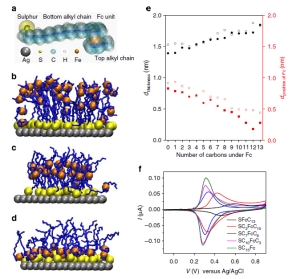
Molecules are channels for charge transport and hold the principle section of molecular junctions. Three subcomponents constitute the structure of SAMs (self-assembled monolayers): backbone(s), substituent(s) and anchor group(s). By studying each of the component separately, it is possible for us to manipulate the properties of the molecular junctions. Moreover, as SAMs consist of a large number of molecules, the supramolecular structure of SAMs ought to be taken into consideration while optimizing the performance of the molecular junctions. Subtle changes in the SAM packing structure can have profound effects on their properties, especially inside tunneling junctions. Therefore we characterize our SAMs in great detail with lab-based techniques (XPS, ARXPS, electrochemistry, etc.).
 >
>
XPS can provide information about the types and relative atomic ratio of elements in SAMs. ARXPS can analyze the thickness of monolayer by element ratio at different depths, which can reflect the intermolecular packing to a certain extent. The surface coverage information of the molecular junction can be obtained by cyclic voltammogram curve. The above methods can characterize the supramolecular structure of molecular junction from many aspects. By optimizing the supramolecular structure, we can get the molecular junction with the best performance. Then we will carry out junction test, using liquid metal EGaIn as the top electrode to apply voltage to the molecular junction, and get J-V (J-current density) curve, which can be used to characterize the performance of molecular devices by the value of current density J and rectification ratio R.
Molecular Device
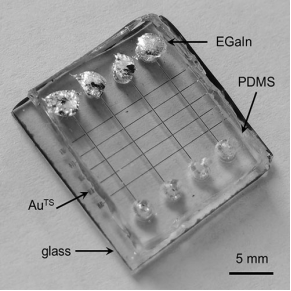
We aim to explore the possibilities of self-assembly and supramolecular chemistry in bottom-up nanofabrication to obtain devices that are organized at the molecular level. We use non-classical approaches that are compatible with the relatively fragile molecules to fabricate molecular electronic devices for applications in molecular electronics.
Synthesis
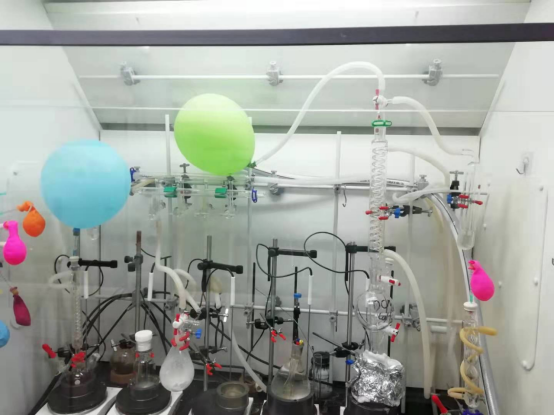
Our synthesis laboratory is fully equipped with Schlenk/vacuum lines and other equipment for the preparation of highly air-sensitive compounds. Our synthesis mainly focuses on redox-active compounds for molecular functional molecular devices, such as molecular diodes, molecular switches, molecular memristors. In most cases, we use the methods that have been reported to prepare our compounds.
 >
>